Table Of Content
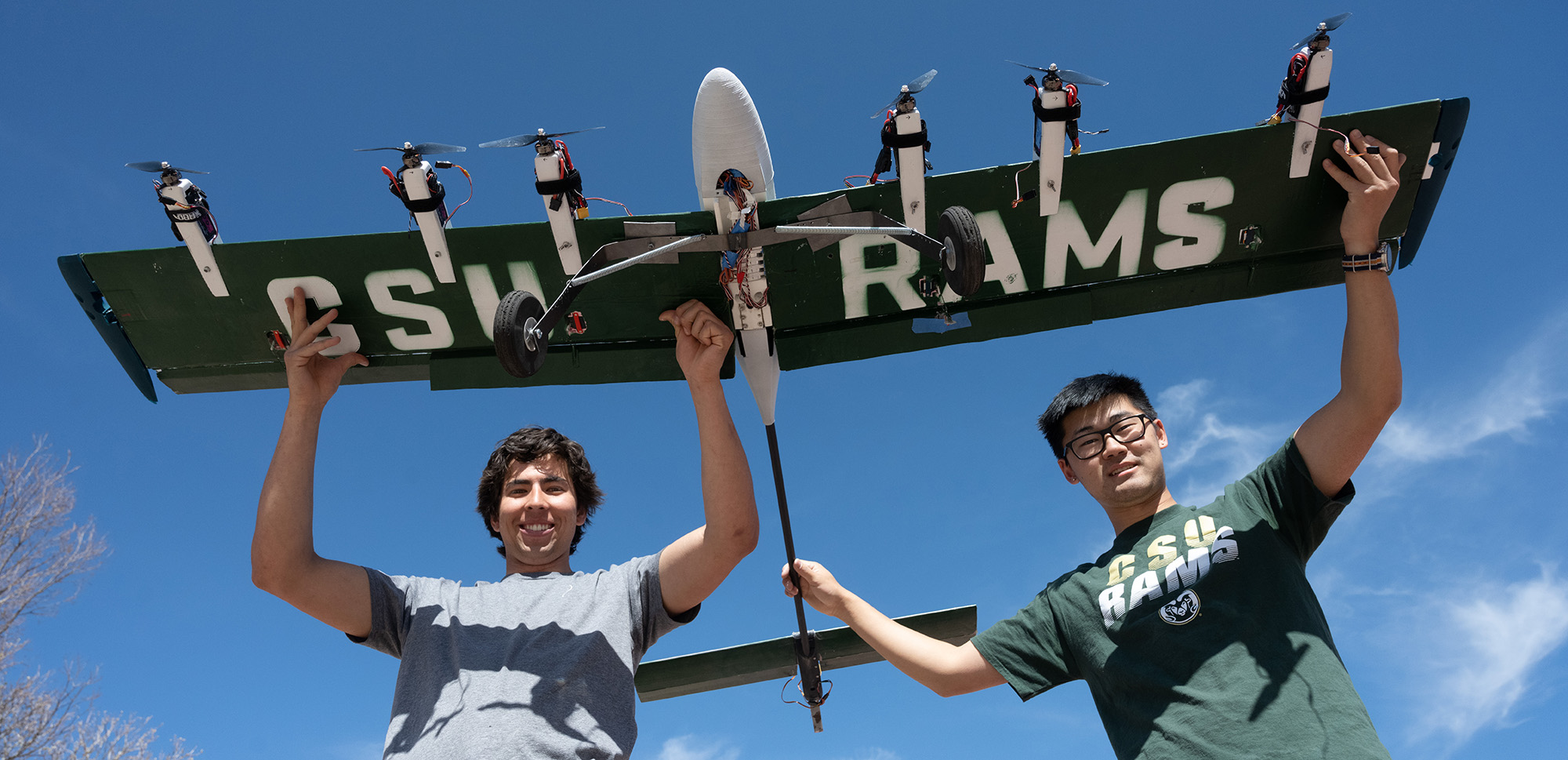
AIAA (American Institute of Aeronautics and Astronautics) DBF (Design Build Fly) is an international engineering competition. Each year, student teams field aircraft for a set of complex missions and compete against each other for the highest score. Through this competition, students gain real-world aircraft design experience. Students working with the team will develop skills with products that will carry over to their professional careers. DBF gives students the opportunity to explore a variety of disciplines within aeronautics and apply what they learn in classes in a setting similar to that of industry. Each year, 300+ teams worldwide submit their design reports- about a third of them are invited to the international flyoff, and even fewer successfully complete all three missions.
The Competition
Teams can use MATLAB and Simulink to design and validate their aircraft as well as simulate mission profiles. The American Institute of Aeronautics and Astronautics Design Build Fly (AIAA DBF) competition is an annual aircraft design competition. Each year students are tasked with designing, building, and flying unmanned, electric powered, remote control aircraft.
Featured Events

After arriving, they still had to contend with a requirement levied by their professors that they assemble the plane entirely on Thursday to help them when the time came to make repairs. Find premiere aerospace technology, engineering, and science content and research across 100+ topics. Other MathWorks country sites are not optimized for visits from your location. Learn how to use MATLAB and Simulink to design algorithms, create simulations, deploy code, and speed up software development for your projects. Whether a potential member, sponsor, or curious site visitor, our team would love to hear from you and answer any questions you may have. “I really see it as a well-rounded project where they pick up technical skills and those teamwork soft skills that really help them become great engineers,” she said.
Come Fly Away with Christie Lau, Future Aerospace Engineer! - UNSW Sydney
Come Fly Away with Christie Lau, Future Aerospace Engineer!.
Posted: Fri, 02 Aug 2019 07:00:00 GMT [source]
Competition Resources
The first flight, Mission 1, consisted of flying two dolls that represented crew members. In Mission 2, the teams completed a medical transport flight, loading their planes with additional dolls that represented emergency medical personnel and a patient. In Mission 3, they were free to carry as many passenger dolls as they chose to simulate the flight of an electric air taxi. In the ground mission, they were scored on how quickly they swapped their aircraft between the medical transport and passenger configurations. This year’s flight objective was to design, build, and test a remotely operated radio control airplane for Urban Air Mobility.
Teams from 12 countries, including 32 US states participated in the full DBF Competition, including submitting design reports and attending the flyoff. This year’s contestants had to complete a written report, a ground mission and three flights. The first flight required completing a mission of three laps around the course with no added weight. The second mission required flying the same distance with a circular, rotating radome as the payload.
This year’s Design/Build/Fly event challenged students to emulate electric passenger aircraft
With 785 students participating on 77 teams, this year’s event was the largest DBF to date. University of Washington in Seattle took third place with a $1,500 award, flying with 75 dolls and completing the ground mission in just under three minutes. Even before the competition was over, some teams were already planning for next year.
To encourage innovation and maintain a fresh design challenge for each new year’s participants, the design requirements and performance objective will be updated for each new contest year. The changes will provide new design requirements and opportunities, while allowing for application of technology developed by the teams from prior years. University of Southern California won a $100 prize for best design paper submitted prior to the fly-off event, and also won the Stan Powell Memorial Award for the team that showed it learned the most. Though USC started the fly-off event in first place, it failed to complete one of the flights. Competition rules vary annually, switching between humanitarian and military themes.
“Aviate, Navigate, Communicate”: The Rules of Flying - USC Viterbi School of Engineering - USC Viterbi School of Engineering
“Aviate, Navigate, Communicate”: The Rules of Flying - USC Viterbi School of Engineering.
Posted: Tue, 20 Dec 2016 08:00:00 GMT [source]
Teams from 14 countries, including 27 US states and the District of Columbia participated in the full DBF Competition, including submitting design reports and attending the flyoff. Student teams will design, fabricate, and demonstrate the flight capabilities of an unmanned, electric powered, radio-controlled aircraft which can best meet the specified mission profile. This year marks the largest-ever flyoff participation, with more than 1,000 students on 93 university teams attending onsite. The flyoff was hosted by AIAA Corporate Member Textron Aviation in Wichita, Kan.
This year’s DBF objective was to design, build, and test an unmanned aerial vehicle (UAV) to deliver and drop vaccine components. Missions included deployment of the aircraft, staging of vaccination syringes, and delivery of environmentally sensitive vaccine vial packages. More details about the mission requirements can be found on the DBF website at aiaa.org/dbf.
From the "womb to tomb" of each competition, we do everything from preliminary design, to CAD modeling, to prototyping and flight testing in fewer than 7 months. “When we got here and crashed out, we were able to build a whole new plane and get out on the flight line the same day,” said team member Jasper Bossett. The Ljubljana team took an early lead at the end of Friday’s flights at TIMPA, the Tucson International Modelplex Park Association Airfield.
This project is commonly used for senior design, but all others can still join. For more information, visit , or follow AIAA on Twitter, Facebook, LinkedIn, and Instagram. Each year students of the University of Washington take part in the AIAA Design, Build, Fly (DBF) competition.
For the third mission, teams competed to drop the most plastic darts within 10 minutes, a drill designed to simulate the release of bombs called attack stores. The ground mission required demonstrating installation of the radome and attack stores and activating both remotely. Students are required to keep up with changing technologies and mission requirements as the aerospace industry advances. Recent mission requirements have included increased focus on fuel efficiency, environmental sustainability, and electric propulsion.
Rules typically release in late September, with the final fly-off in April. A mathematical formula outlined in the rules calculates each entry's score, which lately combines design report and performance scores from fly-off missions. Teams are required to submit the proposal and team rosters via the online submission system. Proposals and team rosters are due by 5 pm (1700) US Eastern Time on 31 October.The proposals will be scored as defined in the proposal requirements section. The top 110 proposals plus ties will be invited to submit design reports and potentially become eligible for the fly-off. Teams will be notified no later than 17 November if their proposal has been accepted or not.
“The goal was to be fast,” Hofbauer said, and that gave the team a strong start. The Ljubljana team chose cutting-edge materials for a broader reason too. Companies are “all using composites in aviation and other things and so are we,” said Timotej Hofbauer, a member of the 18-student team. “We’re following the steps and trying to evolve, push it even more, and we think this is the right way,” he added. A completed entry must be RECEIVED by 5 PM (1700) US Eastern Time on 31 October. Your team leader or faculty advisor should review and complete the Student Competition Software Request Form to take advantage of our software offer.
You can find/compare rules, review contest results, and access the Top teams' reports for a particular contest. The team from Trine University in Indiana had to drive overnight from Colorado after their flight to Phoenix was canceled Wednesday night. Get started with the fundamentals of vehicle development for student competitions like Formula Student using Simscape™. If your team is participating in this competition and needs software, fill out the software request form. “We’ve always done well here, but this is the first time we’ve come in first,” said Riley Cox-Gross, an Embry-Riddle graduate student and pilot who has participated in previous at DBF competitions. We are Embry-Riddle Aeronautical University - Prescott's DBF competition team.
MathWorks is pleased to sponsor the 2024 AIAA Design Build Fly competition. MathWorks will provide software, training, and access to MathWorks engineering mentors and technical support to teams who have completed the Student Competition Software Request Form. After struggling to get off the ramp, Trine completed the ground mission but struggled in the air. Each team offers members the opportunity to obtain experience inwork of their individual fields of interest and manages a design step or subsystem(s)critical to the design and fabrication of an aircraft.


No comments:
Post a Comment